Mermaids, Part 2
From killers to Disney Princesses
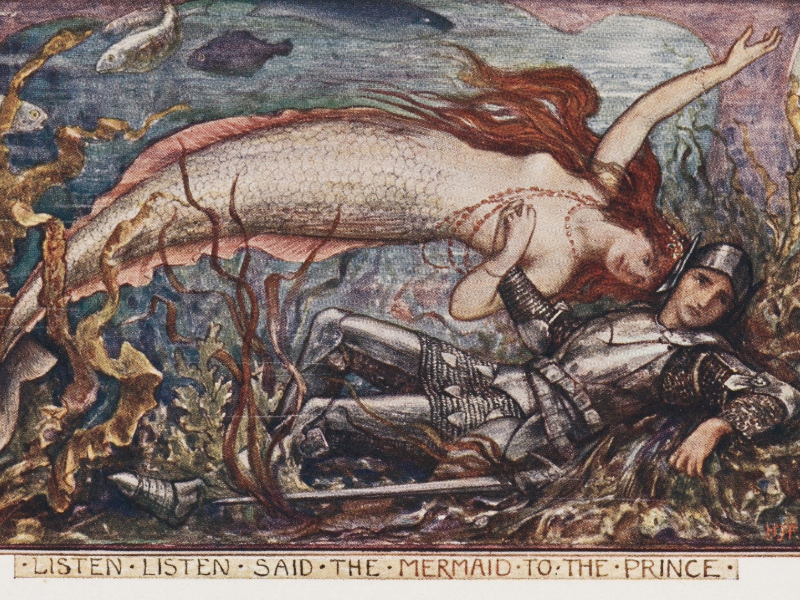
For more than two millennia, mermaids were apex predators whose voices could lure sailors to their deaths. Fast-forward to 1989, and Disney gives us Ariel – a teenage mermaid who voluntarily trades away her voice for the chance to win a very boring prince.
So how did we get from “my voice kills men” to “I'll give up my voice for a man”? And what does this transformation tell us about how we treat both women and the natural world?


-
Steph: Before we begin, a quick content warning: Paranormal Pajama Party is a podcast about scary stories and legends, but there’s nothing scarier than the patriarchy.
When discussing tales in which women are often the villains, we’ll have to unpack some stories in which people are victims.
This episode contains the usual amount of cursing, as well as mentions of environmental destruction, colonialism and environmental racism, and discussion of systemic oppression. Please listen with care.
As we'll explore today, everything in nature is interconnected, and that includes podcast ecosystems. This show grows when it's shared, like some kind of weird mycelial network spreading through a forest floor, except with fewer mushrooms and more terrible puns. So if you know someone who'd enjoy having their worldview turned upside down while learning about sexy fish ladies, send this their way!
She perches on the cliff above the bone-littered beach, her powerful wings folded against her back, watching the merchant vessel cut through the dark sea. Her stomach growls. It's been weeks since the last ship.
Her sisters are already singing, their voices weaving together in harmonies that could make gods weep – and have. But she waits. Patience is everything in the hunt.
The ship draws closer, and she can see the crew clearly now. Young men, mostly. Probably their first long voyage, judging by how they crane their necks to stare at the island. The kind who think they're immortal. The kind that tastes best.
She adds her voice to the song. Not a simple melody mortals expect, but something far more sophisticated. A promise woven from sound itself – the offer of knowledge that no living man possesses. She sings of their homeland, of the lovers they left behind, of secrets that will make them heroes when they return.
If they return.
The effect is immediate. She watches the helmsman's grip loosen, and the ship begins to drift toward shore. One sailor drops his rope entirely, his face slack with wonder. Another is already climbing over the rail, his eyes fixed on the island as if nothing else in the world exists.
Perfect.
The first man hits the water with a splash that barely registers over her sisters' singing. Then another. Then three more all at once, their heavy boots and thick cloaks dragging them down before they surface, gasping and swimming desperately toward the beach.
She spreads her wings and glides down to meet them.
The first sailor stumbles onto the bone-strewn shore, his eyes wide and unfocused, water streaming from his hair. He's young – maybe 19 or 20. He smells like salt and sweat and honest labour. He reaches toward her with trembling hands.
"You're so beautiful," he whispers. "Sing more. Please, just... don't stop singing."
She doesn't stop, but she changes the song now, from promises to commands. Sit down, she sings. Rest. Listen. You don't need food. You don't need water. You only need this.
The sailor sinks to his knees among the bleached ribs and skulls of men who came before him, his face rapturous. His companions splash ashore behind him, one by one, each finding their own spot on the beach to sit and listen and slowly, blissfully, waste away.
She's learned to make it last. The song that keeps them here, keeps them listening, keeps them just alive enough that the dying takes weeks instead of days. Their eyes will stay bright and adoring right until the end, even as their bodies shrivel and their lips crack and their fingernails grow long and yellow.
By the time she's finished with this batch, their ship will have drifted onto the rocks and broken apart. The bones will bleach white in the sun. And she and her sisters will be sated until the next vessel appears on the horizon.
She settles her feathers and continues singing, watching the young sailor's eyes begin to glaze over. Right now, in this moment, he's never been happier.
And she's never been hungrier.
[MUSIC]
Steph: Hi! I’m Steph, and this is Paranormal Pajama Party, the podcast that brings you classic ghost stories and legends featuring female phantoms and femme fatales. Together, we’ll brush the cobwebs off these terrifying tales to shed some light on their origins and learn what they can tell us about the deep-rooted fears society projects onto women.
Welcome back to our underwater grotto! For anyone just joining us, we've relocated our pajama party about thirty feet below sea level to accommodate our aquatic guests. Think of it as the world's most dangerous waterbed – all the comfort of a slumber party, plus the constant threat of drowning!
Last time, we explored how mermaids might be anthropomorphic stand-ins for oceanic indifference – human faces we stuck onto forces too vast and frightening to process directly. We also dipped into why these figures are consistently female across cultures: the ocean as primordial mother, the thing that literally birthed all life on Earth.
But when that oceanic mother turned out to be cold and uncaring rather than loving and protective, patriarchal thinking couldn't handle it. So we created female-shaped scape…fish. Mermaids could embody the ocean's danger in a form we could understand, resist, and ultimately blame for men's poor choices.
And today, I want to look more closely at what happened to those scaly ladies. Because somewhere between Homer's bone-littered shores and Disney's underwater utopia, something fundamental changed.
In their original appearance in the Odyssey, written sometime in the 8th century BC, the sirens' voices are their weapon. In their follow-up appearances, ancient Greek sirens had wings, not fish tails, but as we covered last episode, sirens and mermaids became basically interchangeable over the centuries. Whether they're bird-women or fish-women, the point is the same: their song is lethal. It promises the world and delivers death. These creatures use their voices to kill.
Fast-forward about 26 hundred years, and Hans Christian Andersen gives us the original version of The Little Mermaid. In his story, the mermaid's voice is still incredibly powerful. But she voluntarily gives it up. She trades her voice, her power, her ability to express herself, all for the chance to win the love of a prince who doesn't even know she exists.
For thousands of years, the mermaid's voice was her greatest weapon and defining characteristic. Suddenly, it became something she'd sacrifice for a hot boyfriend.
So how the hell did we get from “my voice kills men” to “I'll give up my voice for a man”?
The answer involves centuries of cultural evolution, religious moralising, and Christopher Columbus proving, once again, that he might be one of history’s greatest assholes.
By the medieval period, mermaids had become standard Christian metaphors for the lure of earthly desires. Dante featured one in his Divine Comedy, portraying her as a beautiful but ultimately repulsive creature who represented the seductive nature of sin itself.
But making mermaids into symbols of sexual temptation created an interesting problem: if you're going to use them to represent irresistible desire, they actually have to be, well, irresistible. Ancient sirens didn't need to be conventionally attractive because their power wasn't sexual – it was in their voices, and what they were singing about was glory and divine knowledge, not sex. But Christian mermaids needed to be visually seductive because now they were explicitly about lust.
So suddenly, we're getting mermaids who are traditionally beautiful rather than just deadly. They start showing up with long flowing hair, perfect breasts, and those famous combs and mirrors – which Christian moralists helpfully explained were symbols of vanity, yet another sin.
And their songs changed, too. Instead of promising passing sailors fortune and glory, post-Christian mermaids are definitely implied to be singing about all the dirty things they'd like to do to you on those sharp rocks if you'll just sail your tall ship a little closer, big boy.
The irony is kind of perfect: Christianity turned mermaids into sexy temptresses specifically to warn people not to be tempted by sexy temptresses.
And it didn't stop there. Christianity also had to domesticate water itself – which earlier religions associated strongly with divine femininity and creation. Now, water had to be blessed by a celibate male priest before it could help save human souls. Baptism became the ultimate symbol of how patriarchal religion could transform dangerous feminine water into something pure and controlled.
At any rate, sex sells, and this new, sexualised version of the mermaid was convincing enough that people started claiming to see them everywhere.
Henry Hudson's crew reported spotting mermaids in the Arctic Ocean in 1608. John Smith – yes, Mr. Almost-Pocahontas – claimed he saw one off the coast of Newfoundland in 1614, noting that “her long green hair imparted to her an original character that was by no means unattractive.”
Aw. John. That is in startling contrast to old Chris Columbus, who managed to be a complete dick even when encountering mythical sea creatures. In 1493, he reported seeing three mermaids near the Dominican Republic. His assessment? They “were not so beautiful as they are painted, though to some extent they have the form of a human face.”
Christopher. Buddy. You're claiming to have encountered actual mermaids – legendary creatures that have captivated human imagination for millennia – and your main takeaway is: “they weren’t that hot”? Not only is that a bad Howard Stern Show take, but, since historians are pretty sure what he saw was a manatee or dugong, it was also pretty rude to sea cows.
But Columbus's disappointment tells us something important: by the late 15th century, mermaids were expected to be beautiful. The idea of an unattractive mermaid was noteworthy enough that he felt compelled to comment on it.
This transformation is classic patriarchy, too – take a powerful female figure, make her about sex and temptation, then blame her for men's inability to control themselves. It's the same logic that brings us such gems as “she was asking for it” and dress codes that police girls' shoulders. Women's bodies become the problem, the source of sin, the thing that leads virtuous men astray.
The really insidious part is that the qualities you assign to a half-fish-woman in the water – that she's a slutty temptress who hurts men through her sexuality – are, by the transitive properties of sexism, also qualities you can assign to non-fish-women on land. If mermaids are dangerous because they're beautiful and sexual, then any beautiful, sexual woman becomes potentially dangerous. Sexualising mermaids didn't just hurt mythological creatures – it hurt actual women by reinforcing the idea that female sexuality is inherently destructive and manipulative.
So by the time the Romantic movement rolled around in the late 18th and early 19th centuries, mermaids had been thoroughly prettified and sexualised. But the Romantics took this in a different direction – instead of dangerous temptresses, they turned mermaids into objects of melancholy beauty.
There’s nothing the Romantic movement loved more than the idea of the unreachable woman, a beautiful creature you could pine for but never possess. Except for maybe the idea of a mad scientist who gave life to and promptly abandoned a monster made out of old body parts. They liked that one a lot, too.
This artistic and literary transformation was happening right around the time Hans Christian Andersen was writing his stories, and you can definitely see the influence in the "Little Mermaid", first published in 1837. Interestingly, the story is told from the so-called monster’s perspective, probably based on Andersen’s own experiences as a bit of an outsider.
But even as he made her sympathetic, he kept her fundamentally monstrous. His little mermaid doesn't have a soul. Every step she takes on her new human legs feels like walking on knives. She doesn't get the prince – he marries someone else. And at the end, when she's supposed to kill him to save herself, she can't do it. She sacrifices herself and dissolves into sea foam, only to be rescued by air spirits who give her a chance to earn a soul through centuries of good deeds.
The message was clear: mermaids could be sympathetic, but they were still fundamentally other. Still dangerous. Still monstrous. Love might make them more human, but it couldn't make them fully human.
The Victorians took this romanticised version and ran with it. Suddenly, mermaids were everywhere in European art and literature, but unlike Andersen's tragic figure, these ones didn’t seem to have much of an internal life. They were decorative objects, spending their time sitting on rocks, combing their hair, and looking wistful. They were mysterious and alluring, but safely passive.
Victorian mermaids were the ultimate embodiment of what the era found appealing about femininity: they were beautiful, silent, and completely inaccessible. They couldn't challenge men, couldn't compete with them, couldn't even exist in the same space as them. Perfect.
And then, in 1989, Disney took whatever was left of the mermaid's complexity and stabbed it to death with a dinglehopper. That’s a deep cut for all my Scuttle the Seagull fans out there.
Disney's Ariel is, as one critic put it, “all heart and no brains” – she's “virtuous because she is incompetent.” She's a teenager who makes catastrophically bad decisions and gets rescued by the men in her life: her all-male animal friends, Prince Eric, and ultimately her father. She doesn't save anyone. She doesn't demonstrate any particular wisdom or power beyond being really, really good at wanting things.
Under the sea, Ariel is active and adventurous. She explores shipwrecks, takes risks, defies her father's rules. She sings about wanting to run, to dance, to be "part of your world." Her voice represents her agency, her desires, her selfhood.
But the moment she trades that voice away? She becomes passive, silent, decorative. On land, she doesn't run anywhere – she sits quietly while Eric's world happens around her. When another woman tries to compete for the prince, Ariel can't even speak up for herself. In the end, she's literally handed over to Eric by her father, like property changing ownership.
The voice that once killed men becomes something she sacrifices for a makeover. And losing it transforms her from an active protagonist into a passive object.
Meanwhile, the only genuinely feminist character in the movie is the villain. Ursula may be competing with Ariel, but it’s not because she wants the man – she wants King Triton's power. She's not conventionally beautiful like Ariel - she's large, older, and looks like John Waters’ favourite drag queen, Divine. She's everything Disney tells us women shouldn't be: loud, powerful, fat, sexually confident, and completely uninterested in male approval.
And how does Disney deal with this feminist threat? They literally penetrate her with a phallic ship's bow. All those rumours about hidden penises on the VHS cover were looking in the wrong place – the real penis was attacking Ursula the whole time.
It's the perfect patriarchal fantasy: the quiet, beautiful girl gets the prince, while the loud, powerful woman gets murdered by penetration. Which happens a lot on this podcast, actually.
This transformation of mermaids from apex predators to perfect princesses can’t all be blamed on Mickey Mouse. Unfortunately, it's part of a much larger pattern of how patriarchal societies have learned to domesticate anything that threatens male authority – including nature itself.
Environmental philosopher Timothy Morton puts it perfectly: “Putting something called Nature on a pedestal and admiring it from afar does for the environment what patriarchy does for the figure of Woman.”
And doesn't that sound familiar? If you listened to the recent episode on the women of “Dracula'”, you'll remember how Van Helsing did exactly this to Mina Murray: put her on a pedestal as the team's pure, spiritual mascot instead of letting her be an active participant in hunting vampires. It sucks! And not in a cool vampire way.
We've taken the ocean – this vast, indifferent force that could kill us in a heartbeat – and turned it into something beautiful and passive that we can admire from our beach resorts. We've domesticated our relationship with the sea the same way we domesticated mermaids, the same way we've domesticated women.
This brings us to a movement that noticed these connections decades ago: ecofeminism. Haha. You knew the feminist theory was coming.
Ecofeminism emerged in the 1970s around a simple but radical idea: the way we treat nature and the way we treat women are connected. Both are rooted, if you will, in the same systems of domination that decide some things are valuable and others are disposable.
The philosophical backbone of this domination is something called dualism – the tendency we have in the West to organise the world into opposing pairs, where one side is always better than the other. Mind versus body. Culture versus nature. Male versus female. Reason versus emotion. Human versus animal.
And notice how these line up? The “good” side always gets associated with men and masculinity: mind, culture, reason, human. The “bad” side gets lumped together with women and femininity: body, nature, emotion, animal. It’s that transitive property of sexism again.
This is not how my seventh-grade geometry teacher thought I would be using proofs.
Anyway, these dualisms create a hierarchy that justifies treating anyone and anything on the “lesser” side as resources to be used, rather than entities with their own value. Women are reduced to their reproductive capacity. Nature gets reduced to its economic utility. Indigenous peoples are treated as “closer to nature” and therefore less civilised. Poor communities get their neighbourhoods turned into dumping grounds. Remember Flint, Michigan? A predominantly Black, low-income community was deliberately given contaminated water to save money, then ignored for years when they complained about it.
The systems that oppress people and the systems that destroy the environment aren't just similar – they're the same systems, and they hit hardest when multiple inequalities intersect.
Another example: in the Arctic, Indigenous women have some of the highest levels of toxic contamination in their breast milk anywhere in the world. These are communities that already face enormous inequities – economic, political, social. And they didn't create that pollution – it comes from industrial processes thousands of miles away in wealthy countries. Chemicals travel through the atmosphere and water systems, accumulating in the Arctic food chain and ultimately in women's bodies.
This is what one scholar calls "multispecies environmental colonialism" – pollution affects the plankton, which affects the fish, which affects the seals, which affects the humans. The people bearing the physical burden of that contamination are Indigenous women – and their infants – who have the least power to stop it and the fewest resources to protect themselves.
And this invisibility informs the actual value of things. Until literally this year, the UN’s System of National Accounts didn't include nature's contributions to the economy until those resources entered the cash market. A river flowing freely through a forest has no economic value – but dam it for hydroelectric power, and suddenly it's worth millions. The river itself, the ecosystem it supports, the climate regulation it provides? Worthless, economically speaking.
Similarly, it wasn’t until 2008 that the UN even encouraged countries to measure women’s unpaid care work — and most still either don’t do it, or do it in very limited ways.
If we valued women’s unpaid labour comprehensively, some countries’ GDP-equivalent figures would jump by a third or more overnight. We don’t, because both women’s work and nature’s work have been treated as free resources that don’t need recognition or protection.
Why do I do this podcast? Honestly, I just get angrier with each episode.
Understanding how dualism maintains itself is actually crucial to understanding why oppression happens. Because dualistic thinking requires constant work to keep those hierarchies in place.
Val Plumwood, the philosopher who really broke down how this system operates, identified several key mechanisms that dualism uses to maintain itself:
First, there's backgrounding – making the contributions of the "lesser" side invisible. We've seen this with unpaid care work and natural resources, but it happens everywhere. Slave quarters on plantation wedding venues? Nothing to see here but beautiful antebellum architecture! Indigenous Acknowledgments of Country that just tick boxes? Just pretty words before the real event starts.
Then there's radical exclusion or hyperseparation - emphasising and exaggerating differences to create an unbridgeable gap between categories. Think incel culture's obsession with “Chads” versus virgins, or MAGA rhetoric about “real Americans” versus everyone else. The differences get magnified until they seem like completely separate species.
There's also incorporation – defining the "lesser" side entirely in relation to the dominant side, usually as a lack or absence. “Mankind” includes women and gender-diverse people, too, don’t worry! People with physical differences become “disabled” compared to the default human body, which looks like the dominant group, of course.
There's instrumentalism – treating the subjugated side as tools or resources that exist solely for the benefit of the dominant side. Women exist to serve men's needs. Nature exists to serve human needs.
And finally, there's homogenisation – treating everyone in the “lesser” category as identical while celebrating diversity in the dominant group. All immigrants have "the immigrant experience." One autistic person can speak for all neurodiverse humans. It’s amazing! Meanwhile, wealthy white men get to be individuals with unique stories and complex motivations ripe for an Oscar-winning biopic.
These mechanisms work together to create and maintain the hierarchies that justify oppression. They're constantly reinforcing the idea that the world is divided into neat categories with clear boundaries and obvious hierarchies.
And it’s honestly kind of hard to see past them. These ideas are so ingrained into the Western way of thinking that scripting the Rangda episode about things being more grey than just good and evil kind of broke my brain. They seem so logical! And who doesn’t feel safer with a nice category?
But these dichotomies are totally false. What if we recognised that the world isn't actually divided into opposing camps, but exists on spectrums and continuities? What if we saw complexity and interconnection instead of separation and hierarchy?
And what could be more challenging to a black-and-white worldview than a super sexy half-woman, half-fish monster? Especially one who’s an actual embodiment of nature itself.
Mermaids have been doing exactly what we all need to do: refuse binary categorisation. They exist between human and animal, culture and nature, beautiful and monstrous, good and evil. This boundary crossing became more complex and layered as their myths became more complex and layered, too, but I think that’s a good thing – it's a model for ecological and gender justice.
Think about what mermaids represent: they're simultaneously rational (they can speak, plan, make decisions) and instinctual (they're driven by oceanic forces). They're cultural beings with language and society, but they're also wild creatures of nature. They're beautiful enough to attract humans but monstrous enough to kill them. They can be nurturing like mothers or destructive like storms.
Every attempt to pin them down into a single category fails. Are they good or evil? Depends on the story, depends on the encounter, depends on your perspective. Are they human or animal? Both. Neither? Something else entirely.
Plumwood argued that escaping dualistic thinking requires us to recognise the contributions of what's been backgrounded, see things on spectrums rather than as binaries, define things independently rather than in relation to a dominant norm, and respect complexity and diversity.
This is exactly the kind of thinking we need to address ecological crises and social injustice. Instead of seeing humans as separate from and superior to nature, we need to recognise our interdependence. Instead of organising society around domination hierarchies, we need systems that honour complexity and relationships. You see, as another Disney princess, whose boyfriend once saw a mermaid, said: We are all connected to each other in a circle, in a hoop that never ends.
But it won’t surprise you to learn that things that defy categorisation – especially female-coded things – make patriarchal systems very nervous. The patriarchy is very nervous and insecure all the time. That’s kind of its thing.
Obviously, as a system of domination, patriarchy’s foundation is based on dualistic thinking. So when something refuses to fit into the neat categories that justify oppression – or encourages us to think about things in a different light, it threatens the entire structure.
Mermaids were dangerous because they proved that the boundaries the patriarchy depends on are arbitrary. If a creature can be both human and animal, then maybe the human/animal divide isn't as fundamental as we pretend. If something can be both beautiful and monstrous, then maybe our aesthetic categories are more fluid than we'd like to admit. If a being can be both rational and wild, then maybe we need to rethink who gets to be considered fully human.
It’s the same way that gender-nonconforming people today are seen as threatening, not because of who they are, but because they challenge the idea that gender is a simple, binary, natural category. And it’s the same way that people of mixed race have historically been seen as dangerous because they blur the racial categories that white supremacy depends on.
Mermaids represent the possibility that all our carefully constructed hierarchies might be... optional. Changeable. Not divinely ordained or naturally inevitable, but human-made systems that can be human-unmade.
And I suspect that's why mermaids and nature itself had to be domesticated, and Ariel had to get a very boring boyfriend.
[MUSIC]
Steph: It’s time for lights out at the Paranormal Pajama Party. I have to say, squeezing this fish isn't quite as satisfying as squeezing a teddy bear, but needs must when you're hosting a slumber party in Davey Jones’ Locker. At least the whale songs are soothing.
To learn more about ecofeminism, environmental and social justice, and the impossibilities of mermaid anatomy, check out my sources in the show notes.
Follow @ParanormalPJParty on Instagram to see visuals from today’s episode.
I also have a Substack newsletter called "Lights Out!" with extra research and behind-the-scenes stuff. It updates about as regularly as a mermaid sighting, but when it does, it's worth the wait. You can find it at paranormalpajamaparty.substack.com.
I’ll be back in two weeks with more spine-tingling tales and critical discussion. In the meantime, don’t forget: Ghosts have stories. Women have voices. Dare to listen.
The answer lies in something environmental philosopher Timothy Morton identified: “Putting something called Nature on a pedestal and admiring it from afar does for the environment what patriarchy does for the figure of Woman.”
We've learned to domesticate our relationship with the ocean the same way we domesticated mermaids, the same way we've domesticated women. The vast, indifferent force that could kill us becomes something beautiful and passive that we can admire from beach resorts.
The ecofeminist connection
Ecofeminism emerged in the 1970s around a radical idea: the way we treat nature and the way we treat women are connected through the same systems of domination. Both are rooted in dualistic thinking that organises the world into opposing pairs where one side is always superior.
Mind versus body. Culture versus nature. Male versus female. Reason versus emotion. Human versus animal.
Notice how these line up? The “good” side always gets associated with men and masculinity, while the “bad” side gets lumped with women and femininity. This creates hierarchies that justify treating anyone on the "lesser" side as resources rather than entities with their own value.
Women are reduced to their reproductive capacity. Nature gets reduced to its economic utility. Indigenous communities face environmental racism. Poor neighbourhoods become dumping grounds. The systems that oppress people and destroy the environment aren't just similar– they're the same systems.
Why mermaids threaten everything
Here's where mermaids become genuinely revolutionary: They refuse binary categorisation entirely. They're simultaneously rational and instinctual, cultural and wild, beautiful and monstrous, nurturing and destructive.
Every attempt to pin them down fails. Are they good or evil? Human or animal? It depends on the story, the encounter, or your perspective. They exist in the spaces between categories, and that makes patriarchal systems very nervous.
Mermaids prove that the boundaries these systems depend on are arbitrary. If something can be both human and animal, then maybe our hierarchies are optional. Changeable. Human-made rather than divinely ordained.
And maybe that's why mermaids had to be domesticated, their voices silenced, their power traded away for a dull prince. Because creatures that embody the possibility of different ways of being are dangerous to systems built on rigid categories and clear hierarchies.
If you're fascinated by the intersection of folklore, feminism, and environmental justice, subscribe to Paranormal Pajama Party for more haunted history with a critical edge.
Sources
Black, Holly. “The Rise of the Feminist Mermaid in an Age of Ecological Crisis.” Artreview.com, 21 June 2023.
Bossi, Larelle. “Blue Ecofeminism: Rethinking Our Oceans and Remembering the Goddess.” Language, Culture, Environment, vol. 1, 2020. Accessed 9 Aug. 2025.
Crane, Stephen. “A Man Said to the Universe by Stephen Crane.” Poetry Foundation, 26 Feb. 2020.
Davidson, Lucy. “Singing Sirens: The Mesmerising History of Mermaids.” History Hit, 31 Mar. 2022. Accessed 11 Aug. 2025.
Eden, Bram. Measuring Natural Capital in the 2025 SNA. Organisation for Economic Co-operation and Development.
Enviroliteracy Team. “Is the Sea a Female?” The Environmental Literacy Council, 29 Apr. 2025. Accessed 11 Aug. 2025.
Faircloth, Kelly. “The Original Sirens in Mythology Weren’t the Seductresses We Know Today.” National Geographic, 22 July 2025. Accessed 11 Aug. 2025.
Farnell, David, and Rute Noiva. “In the Wake of the Mermaid: Our Beautiful Monsters.” Perceiving Evil: Evil Women and the Feminine, edited by David Farnell et al., Inter-Disciplinary Press, 2015, pp. 9–19. Accessed 1 July 2025.
Frasl, Beatrice. “Bright Young Women, Sick of Swimmin’, Ready to … Consume? The Construction of Postfeminist Femininity in Disney’s the Little Mermaid.” European Journal of Women’s Studies, vol. 25, no. 3, 29 Apr. 2018, pp. 341–354.
Gaard, Greta. “Women, Water, Energy: An Ecofeminist Approach.” Organization & Environment, vol. 14, no. 2, 2001, pp. 157–172. JSTOR. Accessed 9 Aug. 2025.
Hight, Elena. Our Waters, Our Selves: A Conversation with Astrida Neimanis. The Center for Culture, History, and Environment, 27 Nov. 2011. Accessed 10 Aug. 2025. Podcast.
Kahane, Guy. “Is the Universe Indifferent? Should We Care?.” Philosophy and Phenomenological Research, vol. 104, no. 3, 14 June 2021. Wiley Online Library. Accessed 11 Aug. 2025.
Keoghan, Mike. “Update on Recent and Upcoming Office for National Statistics (ONS) Environmental Work.” Office for National Statistics, 17 Jan. 2025.
Miles, Kathryn. “Ecofeminism | Sociology and Environmentalism.” Encyclopædia Britannica, 9 Oct. 2018. Accessed 9 Aug. 2025.
Milne, Louise S. ““To Hear the Mermaids Sing”: Visual Figuration, Myth and Desire in the Case of the Waterwoman.” Folklore Electronic Journal of Folklore, vol. 95, 1 Apr. 2025. Accessed 4 July 2025.
Morton, Timothy. “Toward a Theory of Ecological Criticism.” Ecology without Nature: Rethinking Environmental Aesthetics, by Timothy Morton, Harvard University Press, 2007, pp. 1–28. Accessed 11 Aug. 2025.
Plumwood, Val. “Dualism: The Logic of Colonisation.” Feminism and the Mastery of Nature, by Val Plumwood, Taylor & Francis Group, 1994, pp. 53–79. Accessed 9 Aug. 2025.
Triaridou, Nina. “Lamia, Sirens, and Female Monsters: Feminist Reframings of Classical Myth in 19th-Century Literature.” Antigone, 31 Mar. 2022. Accessed 10 Aug. 2025.
“What Is a Mermaid?” Royal Museums Greenwich, 2025. Accessed 11 Aug. 2025.
“Mermaid.” Wikipedia
“Siren (Mythology).” Wikipedia
“System of National Accounts.” Wikipedia
Zuk, Rhoda. “The Little Mermaid: Three Political Fables.” Children’s Literature Association Quarterly, vol. 22, no. 4, 1997, pp. 166–174. Accessed 25 Aug. 2019.