Episode 33: Hagsploitation
What Ever Happened to Baby Jane?
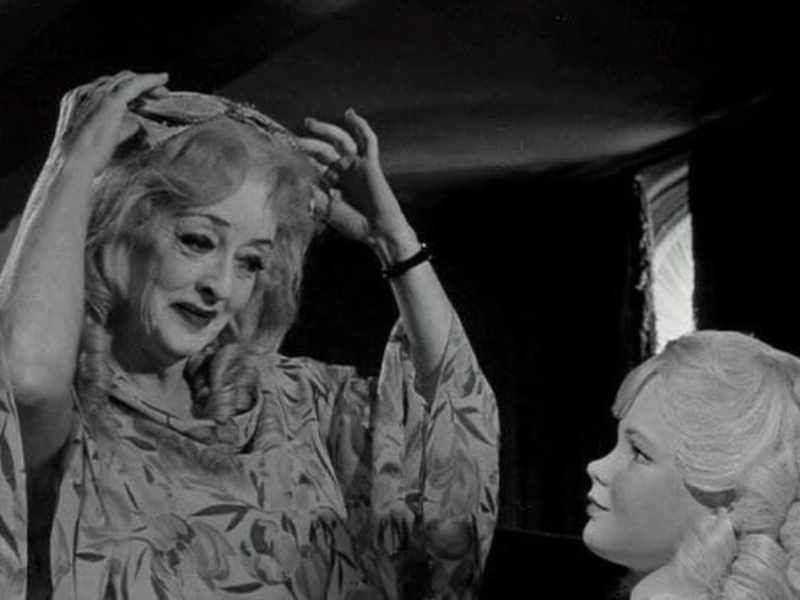
In the landscape of horror cinema, few subgenres are as deeply rooted in cultural anxieties as "hagsploitation" – films that turn aging women into monstrous villains. At the centre of this unsettling tradition stands the 1962 psychological thriller What Ever Happened to Baby Jane?, a film that revitalised the careers of Hollywood legends Bette Davis and Joan Crawford and crystalised society's profound discomfort with women who dare to age visibly.
The birth of a monstrous subgenre
Released on Halloween 1962, What Ever Happened to Baby Jane? tells the disturbing story of two ageing sisters – former child star "Baby Jane" Hudson (Davis) and her wheelchair-bound sister Blanche (Crawford) – locked in psychological warfare in their decaying Hollywood mansion. The film's success spawned numerous imitators with similarly interrogative titles: Hush...Hush, Sweet Charlotte, What Ever Happened to Aunt Alice?, and Whoever Slew Auntie Roo?.
These films share a common premise: a formerly glamorous or powerful woman, now elderly, descends into madness and violence. But beneath this simple formula lies a complex tangle of cultural anxieties about ageing, femininity, and power.


-
Steph: Before we begin, a quick content warning: Paranormal Pajama Party is a podcast about scary stories and legends, but there’s nothing scarier than the patriarchy.
When discussing tales in which women are often the villains, we’ll have to unpack some stories in which people are victims.
This episode contains more than the usual amount of cursing, as well as mentions of misogyny, elder abuse, and alcoholism. Please listen with care.
This episode discusses vicious tabloid rumours – and I'd like to start one now: Paranormal Pajama Party is scandalously underrated. Go ahead, whisper it to your friends, or better yet, shout it from the red carpet. Subscribe, leave a review, and pass it on.
[Phonograph static]
[A little girl’s voice]
I've written a letter to Daddy
His address is Heaven above
I've written "Dear Daddy, we miss you
And wish you were with us to love"
Instead of a stamp, I put kisses
The postman says that's best to do
I've written a letter to Daddy
Saying "I love you"
I've written a letter to Daddy
Saying "I love you"
[Phonograph static fades out]
[MUSIC]
Steph: Hi! I’m Steph, and this is Paranormal Pajama Party, the podcast that brings you classic ghost stories and legends featuring female phantoms and femme fatales. Together, we’ll brush the cobwebs off these terrifying tales to shed some light on their origins and learn what they can tell us about the deep-rooted fears society projects onto women.
I don’t have a sister, so I don’t know what that kind of relationship is like, but after the movie I just watched… I’ll stick with my brothers.
What Ever Happened to Baby Jane?, starring Hollywood Golden Age icons Bette Davis and Joan Crawford was released on Halloween, 1962. It’s an adaptation of a novel by the same name by Henry Farrell, which came out in 1960, and I’m about to spoil the hell out of the story, but you’ve had 65 years to read it and 63 to watch the movie, so whose fault is that?
In 1917, "Baby Jane" Hudson is a spoiled child star touring the vaudeville scene with her stage-manager father. She’s so famous she even has her own merch – a line of life-sized, porcelain dolls that look just like her. Her older sister, Blanche, is shy and mistreated by both Jane and their father. Their mother pleads with Blanche to keep caring for her sister, even as Jane abuses her.
The girls grow up and in their 20s, their fortunes reverse – Jane's popularity evaporates while Blanche becomes an acclaimed star in 1930s Hollywood. Out of loyalty, Blanche insists to her studio that Jane also receives a role for every film Blanche makes, but Jane’s slipping into substance abuse and her performances are… they’re not good.
But in 1935, Blanche’s career ends abruptly when she's paralysed from the waist down in a car crash. Jane is unofficially blamed – she disappears for three days and is found in a drunken stupor, unable to explain what happened.
By 1962, we find them cloistered in their decaying Hollywood mansion – Blanche, elegant and forgotten, confined to the upstairs bedroom (with no elevator, for some reason); Jane, bitter, unstable, and permanently suspended in the frilly infantilisation of her childhood stardom. Now a grotesque alcoholic, she still wears baby doll dresses, does her hair in sausage curls and cakes her face with vaudevillian makeup in an effort to cling to her glory days.
When Blanche’s old films begin airing on TV, attracting new fans, Jane’s jealous resentment explodes. She spies on Blanche and discovers her plan to secretly sell the house and institutionalise her. Enraged, she removes the phone from Blanche’s room – her only connection to the outside world – and begins a campaign of psychological torture, serving her dead pets as meals, mocking her, and starving her.
Jane also begins plotting a comeback, hiring a narcissistic, broke accompanist named Edwin Flagg to help resurrect her act. He’s patronising and obviously just in it for the money – but Jane, lost in delusion, believes she’s on the verge of a triumphant return, and that he might be a little in love with her, too, just like Daddy.
When Blanche finally realises that Jane’s planning to kill her, she drags herself downstairs to call her doctor for help, only for Jane to return and beat her unconscious. Jane calls the doctor back and, chillingly, mimics Blanche’s voice to cancel his visit. She ties Blanche to the bed in her room, locks her in, and also fires their housekeeper, Elvira.
Suspicious, Elvira returns and sneaks back into the house and tries to break into Blanche’s locked room. Jane catches her in the act, lets her in to see Blanche bound and gagged, and then bludgeons Elvira with a hammer and disposes of her body using Blanche’s wheelchair.
When a drunk Edwin arrives at the mansion and blunders into Blanche’s room, he discovers the truth about the sisters’ deadly feud and runs away to inform the police. Panicked, Jane flees with Blanche to the beach where she used to rehearse as a child. Elvira’s body is found and the police are on the lookout for the pair, but it may be too late – Blanche is dying.
As Jane slips further into delusion, Blanche confesses: She crashed the car in 1935 while attempting to run Jane down after becoming enraged by her drunken mockery at a party. She broke her spine crashing into the mansion’s gates and then dragged herself in front of the car to frame her sister. Jane, too drunk to remember, lived for decades in guilt and servitude, haunted by a betrayal she didn’t commit.
As the police close in, Jane – now completely unmoored from reality – dances for a gathering crowd, blissfully oblivious as the officers rush past her to try to save Blanche.
Despite starring two women in their 50s – gross! – who hadn’t played leads on film in about a decade, the film was a major box office success and was nominated for five Academy Awards, winning one. It was so successful, in fact, that it resuscitated Bette Davis’ and Joan Crawford’s stalling careers – again, I can’t tell you how old and disgusting they both were – and launched a popular if sort of short-lived horror movie subgenre – psycho-biddy, AKA Grande Dame Guignol if you’re fancy, AKA hagsploitation if you’re not.
For a film to count as hagsploitation, it should meet the following criteria: 1) It features a female character who’s at least 50 years old; 2) This woman is fucking insane and uses that insanity, of her own volition, to terrorise the people around her, usually with over-the-top violence; 3) This insane woman is central to the plot; and 4) The actress who plays the character must be past her prime, as defined by men, I guess.
What Ever Happened to Baby Jane? is, like, the foundational text of the genre. When we think of older women going nuts, we think of this movie first. And then maybe Grey Gardens, but at least their mental illness was kind of non-threatening unless you were a cat trying to navigate the horde.
A bunch of movies came after Baby Jane, many of which starred either Davis or Crawford (although never together again, for reasons we’ll discuss shortly). They all had similar naming conventions, too: Hush… Hush, Sweet Charlotte, What Ever Happened to Aunt Alice?, Whoever Slew Auntie Roo?, What’s the Matter with Helen? There’s a reason for that, too. We’ll get there – hold your girdles.
The hagsploitation film’s heyday was the 1960s and ‘70s, which makes sense because that was about 40 years after the advent of Hollywood’s Golden Age, and one of the things that made hagsploitation work so well was that the actresses hamming it up and losing their minds and dignity on-screen were the former untouchable golden goddesses of the silver screen. The juxtaposition of these grande dames and the depths they were willing to go through on camera kept audiences buying tickets.
These certainly weren’t the highbrow films that actresses like Joan and Bette had glittered their way through in the ‘30s. One of the best things about the horror genre is that its already-shocking nature makes it easier to include other taboos – things that wouldn’t sit well with polite company. Things like abortion. Mental illness. Lesbianism.
B-movie directors milked those psychotic former A-listers as long as they could, but hagsploitation films began to die out around the same time as the stars that made it possible. Joan Crawford died in 1977, around the same time that one horror scholar says the subgenre’s star had fallen, too. I don’t think it died, though. I think it just retired to its dressing room to prepare for its next closeup.
As a subgenre, hagsploitation is… problematic. I can’t really decide how I feel about it. For one thing, it was 100 million percent born out of deep, deep misogyny.
The whole reason hagsploitation exists is Hollywood's utter disdain for female stars past their – and I hate this term – “shelf life”. Women like Davis and Crawford helped build Hollywood, making huge profits for studio heads who then discarded them the moment they hit middle age.
And more than half a century later, the industry hasn't improved much. Research suggests today's Hollywood actresses still have an average career lifespan of just five years, while male actors can remain bankable stars for decades. As actress Geena Davis once pointed out after being told she was too old to play the love interest of a man 20 years her senior, women actors peak in their 20s and 30s, and men peak in their 40s and 50s.
Actually, Geena has a lot to say about this. According to the Geena Davis Institute on Gender and Media – yeah, she started an institute that champions equitable representation in media. And yeah, I am in love with Geena Davis. Anyway, according to research from her institute, female characters aged 50 and above made up only 25.3% of characters in that age bracket in 2019’s top-grossing films in Germany, France, the UK, and the US.
Older female characters were also four times more likely to be depicted as senile than older male characters, and more likely to be portrayed as physically unattractive, frail and homebound compared to their male counterparts. Of the films analysed, just one in four passed the institute’s “Ageless Test”, which is literally only that there has to be one 50+ female character who’s essential to the plot and not an ageist stereotype. It’s not a difficult test!
I recognise that calling Hollywood’s treatment of women sexist and ageist isn’t exactly groundbreaking stuff, and in some ways, I feel gross even bringing it up at all. Why make a fuss about rich, powerful women having a hard time when there are so many marginalised women who would benefit from having their struggles platformed? I’m sure Blake Lively’s crying all the way to the bank.
The larger point is that representation matters – not just for the actresses who can’t get a job after 50, but for all of us. When even the most privileged women are written off and shit-out-of-luck the moment they age out of being fuckable, what does that say for everyone else?
But also, the part of me that’s rolling my eyes about defending wealthy celebrities’ right to get richer – and I hate to admit this – is the same part of me that secretly loves watching a celebrity trainwreck.
And that’s the feeling that makes hagsploitation work. It’s all well and good for us to say, “Ugh, Hollywood. The industry just chews women up and spits ‘em out, huh?” and go on our merry way, but that ignores the crucial fact that we, the movie-going audience, are complicit in this. Hagsploitation movies show us the thrill of the fall. They invite us to laugh, gawk, revel in the downfall of these “has-beens.” And it works because it taps into something nasty and buried: that schadenfreude we feel when a goddess stumbles. Not in spite of her status, but because of it.
So that’s enough to give me the ick. But then there’s the other side of the hagsploitation coin: Because the actresses in hagsploitation films like What Ever Happened to Baby Jane?, discarded by Hollywood, took their power back… by playing madwomen.
There’s this weird contradiction at the heart of hagsploitation. On one hand, this genre – born out of crazy misogyny, double standards, and general nastiness – absolutely degrades older women.
Thanks to lengthening lifespans, it’s estimated that the average American woman will live 40% of her life postmenopausal, and hagsploitation turns this enormous chunk of the population into monsters. It mocks their desperation and fixates on their bodies in wildly cruel, exaggerated ways.
It exploits them twice over: first as characters – these grotesque, broken-down caricatures of womanhood – and then again as actresses. Joan Crawford and Bette Davis, titans of the Golden Age, are suddenly framed as pathetic, unhinged, laughable. Their ageing faces are the horror. Their fading relevance is the punchline. There’s something undeniably brutal about watching a former star reduced to eating rats and dragging herself down a staircase. There’s a real sense of spectacle in seeing someone who once symbolised glamour and control get utterly dismantled on screen. It’s cruel.
But here’s the catch: they’re still the leads, and these roles are good.
For many of these women, hagsploitation offered one of the only paths back to major, meaty roles. It gave them the chance to perform again, playing characters with agency and complexity. And these weren’t passive background roles or doddering grandmas – these were unhinged women with grudges and agendas. Sometimes they were victims of circumstance – but they were always active threats. They got to scream, seduce, scheme, kill.
And for maybe the first time in many of these actresses’ careers, they weren’t starring in films where their character was just an accessory, or a love interest, or a plot device. They are the plot. The men in hagsploitation films are mostly background noise – bumbling cops, oblivious neighbours. The drama is driven entirely by women: their rage, their pain, their madness. They got to dominate the screen.
Sure, the genre leans hard into melodrama and stereotypes about women – but in doing that, it also highlights the ridiculousness of those stereotypes. Because these are stories about women, they largely take place in the domestic sphere, forcing us to examine household dynamics. Our obsession with beauty, our horror of aging, the idea that a woman is only valuable when she’s desirable – it’s all there, dialled all the way up, so far that it starts to feel absurd. So absurd that it turns into critique.
And like I said, these films allowed people to talk about things they couldn’t talk about anywhere else. Topics like addiction and homosexuality were taboo – but if you framed them through a “crazy old lady” character, suddenly you could slip them into mainstream cinema.
These films mock actresses for daring to stay visible, but they also can’t look away from the spectacle and the performance. Because the other thing is that these actresses deliver. Joan Crawford and Bette Davis aren’t phoning it in. They’re giving completely committed, extremely compelling performances. Bette Davis was nominated for the Oscar for Best Actress for Baby Jane. So even as the films ask us to gawk at their fall, the women themselves are reminding us why they were stars in the first place.
Which is probably why critics are so torn – and I am, too, to be honest. Some writers say this subgenre is misogynistic, built on a system that only allows women to be stars when they’re young and beautiful, then laughs at them when they come crawling back. They point out that almost every name for the subgenre – hagsploitation, hag horror, psycho-biddy – is drenched in ageism and sexism.
But others argue it’s subversive. That it knows the system is broken, and uses that to let women go off the rails. To be messy. To be ugly. To be unfeminine. And that if we call these roles “beneath” the actresses, maybe we’re the ones assuming they were desperate. Maybe they weren’t. Maybe they saw a chance to say something – and took it.
Hagsploitation lives in that contradiction. It glorifies its women even as it punishes them. It gives them power just to take it away. And the result is a genre that’s both exploitative and empowering, often at the exact same time.
And speaking of the tension between the grotesque and the beautiful… If you thought we were going to get through a single episode without mentioning the monstrous-feminine, you thought wrong.
So one thing that’s key to the idea of the monstrous-feminine is abjection. Based on Sigmund Freud’s work, philosopher Julia Kristeva defined “the abject” as the stuff that makes us uncomfortable because it blurs boundaries – between self and other, life and death, subject and object. It’s messy, leaky, and rejected. Blood is abject, so is faeces, dirt, corpses. All the gross stuff. It’s what we push away to define what’s “normal.”
Obviously, showing us the abject is what makes horror films, you know, horrifying. And when it comes to women, that discomfort often centres on our bodies – especially when they stop behaving the way they’re “supposed” to on the reproductive front. Horror loves to take menstruation, motherhood and menopause and make them monstrous. So it’s really easy to turn ageing women – women who are no longer fertile, no longer visibly desirable – into shorthand for death, decay, and revulsion.
It happens all the time. Remember the part in The Shining, where a beautiful naked woman appears in the bathtub of Room 217 from nowhere and gets out to seduce Jack Nicholson? First he’s into it, even though she’s, you know, definitely a ghost, because at least she’s hot. But then shock! Horror! She’s revealed to be a decrepit old woman. His revulsion at his own arousal is part of the scare.
I think it’s a cheap trick, personally, but it works because we’ve been trained to fear ageing women’s bodies. But that also means that an enormous proportion of the world’s actual population is, in society’s eyes, grotesque. And remember – these scary old women make up a not insignificant chunk of the small fraction of older female characters that my dear friend Geena Davis was talking about. And since The Golden Girls has been off the air for 32 years, it’s not too crazy to assume that a disproportionate number of on-screen women over the age of 50 is made up of a monstrous old hag who’s off-putting just because of her age and body.
Hagsploitation is just one of many horror subgenres that turns the ageing female body into a site of horror. Even before the characters do anything, they’re horrific because of what they are. You’re supposed to look at them and feel unsettled. Not because they’re supernatural, but because they’re old.
This isn’t just a horror thing, either. Across the media and throughout our lives, we treat women basically as fancy vessels for making babies. The particular horror of menopause, then, is that it now the machine that makes babies looks like it’s fine, but it’s broken. We just don't know how to handle that! Barrenness becomes this weirdly transgressive state that Freud and the people who came after him would say subconsciously freaks people out.
Four years after Baby Jane was released, a doctor named Robert A Wilson published a book called “Feminine Forever”, in which he described menopause as a “state of living decay” for female reproductive organs. That’s zombie talk, and also why you should probably think twice about taking advice on how to be a lady from a dude.
The same source that taught me about Dr Bob’s opinions on ovaries pointed out that it can be argued that women's bodies are never not seen as abject by men – we're just abject in different ways throughout our lives. Pre-pubescent? Incomplete. Menstruating? Unclean. Menopausal? Decaying. It's a never-ending cycle of bodily judgment.
Another of my sources pointed out that even when we're being treated as disgusting, we're still objects. The male gaze doesn't go away – it just switches from “Yeah, I'd hit that” to “ew, gross.” Either way, we're still not people.
No one actually cares what ever happened to Baby Jane. That’s the whole point. The title of the movie and many of the other hagsploitation films that followed are questions because they're highlighting the invisibility of the central older woman. The real question the movie is asking is "What ever happened to youth and the glory that came with it?" And it answers it by pointing out again and again that it's gone, that clinging to it makes you more horrific, and that becoming old is physically and emotionally painful, makes you invisible, makes you pathetic, makes you abject. It’s not “What ever happened to Baby Jane?", it’s "What happens to any woman once her youth is gone?" The answer, over and over again, is horror.
The film didn’t win any acting awards, but it did win the Oscar for costume design in the black and white category, that’s because Jane’s look is vitally important. Her makeup is caked on and out of date, like something from her childhood vaudeville shows. She’s not trying to look young, exactly – she’s trying to look like herself as a child. Her dresses are adult-sized versions of the little girl outfits she wore in her prime. The life-sized doll version of Jane keeps popping up, frozen in time as a little girl, contrasting disturbingly with her aged, alcoholic body and musty, age-inappropriate clothes.
But she’s also sexual. There’s this twisted element where she’s still trying to be desirable, especially with Edwin, who she’s hired as her accompanist, taking the same role her father had back in the day. She’s flirty with him and quickly becomes infatuated with him in a very childlike way – and it’s uncomfortable because we’re not used to seeing elderly women express desire, especially not women who look like that. Her age, her mental illness, her makeup – all of it makes her attraction repulsive, to him and to us. It’s horror built on revulsion. She’s not just a has-been; she’s unfuckable, and that’s the real crime, isn’t it?
When you look at What Ever Happened to Baby Jane? through the theory of abjection, it’s honestly kind of a perfect case study. Baby Jane is pure abject. She’s stuck between categories – between childhood and old age, between celebrity and obscurity, between who she used to be and who she’s become.
What makes her so unsettling isn’t just the cruelty or the tantrums – it’s the fact that she refuses to fit into any neat box. She’s got a child’s face painted onto an elderly woman’s body, nursery rhymes coming out in a broken voice, dainty little curtsies done with stiff, arthritic hands. That collapsing of boundaries is exactly what Kristeva means by abjection – things that disturb identity, that don’t respect borders or rules. Things that make us recoil because they don’t stay where they’re “supposed” to.
And then there are the big, nasty moments: Jane lifting the silver platter to reveal a dead bird – or worse, a rat – served up as a hot meal. Food becomes corpse. Care becomes cruelty. The house turns into a site of horror. All the places that are supposed to feel safe and domestic, especially for women, get turned inside out. Kristeva talks about how the abject produces a physical reaction – a kind of gag reflex. These scenes? That’s it. That’s the feeling.
Even the relationship between the sisters is abject. The line between love and hate gets so blurry it basically disappears. Jane is Blanche’s caregiver, but she’s also her tormentor. She feeds her – dead animals. She watches over her – by keeping her prisoner. There’s no clear separation between nurture and destruction, just a horrifying tangle of both.
In contrast to Jane, Blanche dresses her age and remains elegant – but she’s abject too, not just because of her age but because of her disability.
Compared to Jane, Blanche seems to have handled her abrupt fall from stardom well, but she’s also clinging to a distant past when she was young and more mobile. Interestingly, the movie uses a lot of clips and pictures from Bette’s and Joan’s time in Hollywood to help tell the story and really hammer home how faded these beauties are.
There’s a gorgeous portrait of a young Blanche hanging above the character’s bed. When Jane ties her up in the final third of the film, that image looms over Blanche’s body, reminding us of everything she’s lost. And despite being abject because she’s menopausal and in a wheelchair, she’s sexually objectified in this position. When Edwin stumbles drunkenly into her room, his first glance is a little lascivious – she’s a beautiful woman bound to a bed, watched over by a reminder of her former physical glory. Then the abject creeps back in – he realises her condition and blurts out, “She’s dying!” before running from Jane’s creepy embrace. Blanche stops being desirable and becomes as pathetic as her sister.
And then, of course, there’s the twist ending. The so-called “good” sister was actually the villain, the "evil" sister a victim of gaslighting and manipulation. That revelation completely breaks the moral categories we’ve been using to make sense of the story. It dumps us into that same messy, disorienting place – where good and bad, victim and villain, care and harm all collapse into each other. That’s the heart of abjection. And Baby Jane is twirling her way it.
There is one group of people who can’t get enough of a middle-aged movie star past her prime and hamming it up, though – especially ones as glamorous and cutting as a snarky Golden Age goddess like Joan Crawford or Bette Davis. The rest of the world may fear the hag, but in drag and queer culture, these very same women are celebrated.
Hagsploitation’s melodrama and famous faces doing outrageous things makes it campy catnip, and some of the films are pretty queer-coded. Joan Crawford herself was an ally and seems to have been a member of the rainbow community – she was married four times to men but had sexual affairs with women throughout her life. I wouldn’t call Bette an ally – more a product of her time – but she didn’t hate that she was embraced by the LGBTQ+ community in her later years.
And honestly, it makes sense. These actresses were bold. They were brash. They were deeply extra. Bette and Joan were queens before drag queens made it official. It wasn’t just their acting – it was the whole persona: the eyebrows, the shoulder pads, the withering side-eyes and perfectly timed zingers. They were fabulous.
But it’s more than just fabulousness. Hagsploitation centres people who’ve traditionally been pushed to the margins. These are characters who are punished for being too much, too old, too grotesque, too loud – and that resonates with queer audiences who’ve spent a lifetime navigating the discomfort of being seen as excessive or deviant themselves. Baby Jane is terrifying, sure, but she’s also tragic and theatrical and relentless – and that resonates with anyone who's ever had to perform for survival.
There’s something cathartic in watching a woman fall apart onscreen and knowing she’s taking the whole damn house down with her. Horror and queerness both thrive in spaces where boundaries collapse – between good and evil, beauty and decay, mother and monster, man and woman. And hagsploitation gives us all of that, wrapped in a moth-eaten feathered dressing gown.
And, of course, there’s the fact that Bette and Joan hated each other. Or at least, that’s what the tabloids wanted us to believe. Their famous feud goes all the way back to the 1930s – and, unfortunately, it started over a boy. Bette had fallen hard for her co-star Franchot Tone, only to watch him get swept off his feet by Joan, who promptly married him. The two women spent the next several decades exchanging barbs in the press, taking passive-aggressive swipes at each other’s looks, talent, and love lives.
Despite all the years of backbiting, it was Joan who approached Bette to do Baby Jane, knowing a good part when she saw it. They might have hated each other, but they also understood each other – and the industry – better than anyone else.
The on-set tension was legendary: Joan supposedly weighed herself down with rocks in one scene and repeatedly ruined the take so that Bette, who had back problems, would struggle to drag her across the floor. Bette allegedly installed a Coke machine in her dressing room – a petty jab at Joan’s husband, then president of Pepsi.
It was actually after the movie’s success, when Bette got an Oscar nomination for Best Actress and Joan didn’t, that things really flared up again. Bette lost, but Joan – who had arranged to accept the award for winner Anne Bancroft, who couldn’t attend – took the stage and appeared in all the after-party photos, clutching the statuette and smiling with the other winners. Bette later said, “I was paralysed with shock. To deliberately upstage me like that – her behaviour was despicable.”
But long before that night, their legendary and well-covered feud was a huge part of what made What Ever Happened to Baby Jane? a hit. We, the audience, loved it. We ate it up. The catfight fantasy was too delicious to resist: two aging divas clawing at each other in real life and on-screen, their old wounds spilling into their performances.
Never mind that they were both seasoned professionals, delivering nuanced performances in a bold, risky film. Audiences didn’t want a story about two incredibly talented women navigating a difficult collaboration – we wanted them to destroy each other. And that’s part of the horror, too. The horror of watching a woman age. The horror of watching her fall apart. And the pleasure – for many of us – in watching it happen.
Hagsploitation may have retired to its dressing room for some well-deserved beauty sleep, but it’s sweeping back into the spotlight – mascara smudged, lipstick smeared, and ready to kill. Mia Goth played multiple roles, including the elderly maniac in Ti West’s X trilogy, starting in 2022. Jessica Lange and Frances Conroy reign over literally every Ryan Murphy-created horror series I can think of, and Sarah Paulson just turned 50, too, so I doubt we’ve seen the last of his psycho biddies. Last year at Cannes, everyone lost their mind over Demi Moore in The Substance, which is 100% hagsploitation despite Demi Moore still looking like, well, Demi Moore.
As long as misogyny is a problem in Hollywood and audiences follow celebrity gossip, hagsploitation will have a place in horror. So when you catch the next one at the theatre, take a minute to think about your role in the piece. Are you cheering for women who’ve escaped the cages of respectability? Or are you revelling in the spectacle of their suffering? Horror has always shown us what we fear. Hagsploitation shows us what we enjoy a little too much.
[MUSIC]
Steph: It’s time for lights out at the Paranormal Pajama Party. If you’ll excuse me, I’ll be in the attic with my old theatre costumes, a music box, and a few unresolved issues.
To learn more about hagsploitation, equitable representation in media, or the lurid details of Bette’s and Joan’s feud, check out my sources in the show notes.
Follow @ParanormalPJParty on Instagram to see visuals from today’s episode, when I remember, which is occasional.
I’ll be back soon with more spine-tingling tales and critical discussion. In the meantime, don’t forget: Ghosts have stories. Women have voices. Dare to listen.
Hollywood's discarded goddesses
The bitter irony that fueled hagsploitation was that it existed because Hollywood had no use for actresses once they reached middle age. Both Davis and Crawford had made more than 65 feature films each and helped build the studio system that ultimately discarded them when they aged out of leading lady roles.
Research from the Geena Davis Institute on Gender and Media confirms this pattern persists today. Female characters aged 50+ made up only 25.3% of characters in that age bracket in top-grossing films across major markets in 2019. Even more troubling, these characters were four times more likely to be depicted as senile or housebound than their male counterparts.
The monstrous-feminine and abjection
What makes Baby Jane so deeply unsettling is how it embodies philosopher Julia Kristeva's concept of "abjection", the human reaction to a threatened breakdown in meaning caused by the loss of distinction between subject and object, self and other.
Baby Jane Hudson exists in a disturbing liminal space – an elderly woman wearing a child's makeup, performing nursery rhymes in a cracking voice, seeking childlike adoration while committing horrific acts of violence. Her body and behaviour refuse categorisation, making her the perfect embodiment of the abject.
The film's most visceral moments highlight this quality: Jane serving Blanche a dead parakeet on a silver platter transforms food into death, nourishment into poison. The traditional female domain of caregiving becomes perverted as Jane "cares" for her sister through starvation and psychological torture.
Exploitation or empowerment?
The contradiction at hagsploitation's heart is that while the genre degrades older women by turning them into monsters, it simultaneously provided rare opportunities for ageing actresses to play complex, dominating characters. These weren't passive grandmother roles – these were women with agency, agenda, and screen time.
This contradiction explains why films like Baby Jane found passionate supporters in queer communities, who recognized the subversive power in these grotesque performances. Davis and Crawford might be playing monsters, but they're commanding the screen, refusing invisibility, and showcasing tremendous talent that mainstream Hollywood had no interest in utilising.
Hagsploitation today
The subgenre continues to evolve in contemporary cinema with films like Ti West's X trilogy featuring Mia Goth, Ryan Murphy's various horror series starring Jessica Lange and Frances Conroy, and Demi Moore's recent turn in The Substance. Despite cultural progress in many areas, our discomfort with ageing women – particularly those who refuse to age "gracefully" – remains a potent source of horror.
As we continue to examine these films, we must ask ourselves: Are we cheering for women who've escaped the cages of respectability? Or are we reveling in the spectacle of their suffering?
Sources
Bastién, Angelica Jade. “The Story behind Joan Crawford and Bette Davis’s Storied Feud.” Vulture, 2 Mar. 2017.
“Bette Davis & Debbie Burton – I’ve Written a Letter to Daddy.” Genius, 2025.
Buchanan-King, Mindy. “Joan Crawford: Problematizing the (Aging) Female Image and Sexuality in What Ever Happened to Baby Jane?” Quarterly Review of Film and Video, vol. 37, no. 5, 18 Sept. 2019, pp. 408–430.
Complex, Valerie. “Geena Davis Decries Ageism in Hollywood; Was Told She Was Too Old for Role by Potential Male Co-Star.” Deadline, 12 Jan. 2022.
Dibdin, Emma. “A Timeline of the Real Feud between Bette Davis and Joan Crawford.” Harper’s BAZAAR, 22 Feb. 2017.
Gallagher, Caitlin. ““Feud” Depicts “Hagsploitation” in All Its Offensive Glory.” Bustle, 10 Apr. 2017.
Geena Davis Institute on Gender and Media, and NextFifty Initiative. “Women over 50: The Right to Be Seen on Screen.” 2020.
Geena Davis Institute on Gender in Media, et al. “Frail, Frumpy and Forgotten.” 2019.
Gender_in_horror_films – Psycho-biddy - Wikipedia
Heller, Dana. “Hagsploitation, or the Queer Sublimity of “Feud: Bette and Joan.”” Ryan Murphy’s Queer America, edited by Brenda R Weber and David Greven, London, Routledge, 2022, pp. 56–72.
Keegan, Rebecca. “The Birth of “Hagsploitation” - North Shore.” Chicagotribune.com, 2020.
“Living Deaths, Menstrual Monsters and Hagsploitation: Horror And/of the Abject Barren Body.” Women, Monstrosity and Horror Film, by Erin Harrington, London, Routledge, 10 Aug. 2017, pp. 223–270.
Pahle, Rebecca. “A Primer for the Unexpectedly Awesome Hagsploitation Horror Subgenre.” SYFY Official Site, SYFY, 24 Oct. 2019.
Tomasz Fisiak. “Grande Dame Guignol at 60: A Review of Crazy Old Ladies: The Story of Hag Horror by Caroline Young (BearManor Media, 2022).” Text Matters, no. 13, 27 Nov. 2023, pp. 510–514.
Walker, Billie. “Hagsploitation: Horror’s Repulsion of the Ageing Woman.” Refinery29.com, 28 Mar. 2022.
What Ever Happened to Baby Jane? Directed by Robert Aldrich, Warner Bros. Pictures, 31 Oct. 1962.